15 September 2009 [Updated: 2.5.2010]
Humanitarian Resource Institute
Phone: (203) 668-0282
Url: www.humanitarian.net
Global Arts Integration Into Education Initiative
Url: www.unarts.org
Twitter: unarts
Preventing Joint Damage
and Stabilization in Classical Ballet Training
Global initiative targets focus on neglected fundamentals in the field
of Orthopedics
Today, in the field of orthopedics, the fundamentals of simple correct
posture and alignment have been omitted from the medical school curriculum.
As a result, the use of prescription, nonprescription drugs and surgery dominates
the symptomatic treatment landscape.
There is nothing more upsetting, than seeing a young dancer who exhibits
joint stabilization and developmental deformities due to forced turnout,
see a top orthopedic surgeon, who does not even check if the student has
the capacity to parallel plie.... focusing on expensive surgical procedures,
instead of a concentrated focus on the mechanism of injury. -- Stephen
M. Apatow, Sports Medicine & Science Institute, International Dancescience
Development Program.
Related: Ankle Injuries:
Musculoskeletal Medicine, Essential Dance Medicine, Ana Bracilovic, DOI
10.1007/978-1-59745-546-6_2
Classical
Ballet Based Biomechanical Analysis and Orthopedics 101
Distance Education Course:
Humanitarian University
Consortium Distance Education Initiative
Classical
ballet training represents the most advanced technical movement mechanics
training in the world. The mechanical alignment ideal in classical ballet
training represents the most stable, functionally integrate relationship
of the spine and extremities.
An understanding
of mechanical ideal is crucial for optimum control of the human frame in
space, strength, leverage mechanics and economical movement. This foundation
established in conjunction with sports specific movement mechanics is the
key to successful Olympic development programs.
A correct
understanding of the classical ballet mechanical ideal provides the physician,
therapist, coach or student a reference point for alignment deviation as
it corresponds to the mechanism of joint stress and injury of the spine
and extremities.
According
to the Merck Manual of Medical Information for Sports Injuries: "More than
10 million sports injuries are treated each year in the United States."
The seriousness of this problem points to the need for education initiatives
which target injury prevention.
The Mechanical Ideal
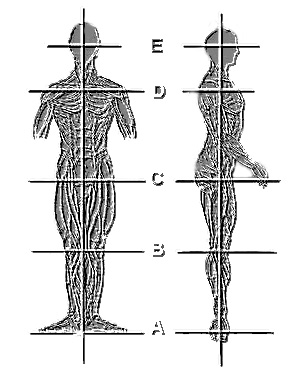
Orthopedics Fundamentals 101 encompasses
a basic understanding of classical ballet based postural alignment.
|
In order to develop precision control
of the human frame and center of gravity, the body must be correctly aligned
and connected as one unit (bottom of the feet to the top of the head).
To do this, the weight must be placed over the center of the feet
(A), with even distribution, connected to facilitate progression to demi-pointe
and pointe.
Incorrect weightbearing on the foot/ankle complex corresponds
with numerous injuries including ankle sprains, achilles tendonitis and
bone growth patterns (bunions) to accommodate abnormal stresses.
As the legs are bent, the knee caps (center of patella) should track
directly over the center of the ankle and foot (A,B).
If a plumbline drops to the inside of the foot complex, internal rotation
of the knee joint is the cause of many developmental challenges that include
the most common mechanisms of knee injury (internal rotation) and torsional
stresses of the ankle/foot complex .
Hip rotation (C) is the determining factor for the functional turnout,
based on correct alignment of the knee, ankle and foot complex. Working
outside of the range of motion in the hip complex contributes to significant
compensatory torsional shifts in the pelvis and spine which contributes
to the mechanism of numerous neurological and lower extremity problems.
The upper and lower extremities are connected by the abdominal and
erector muscles of the lower back. Lack of abdominal strength and connection
of the erector muscles (controlled lordosis) combined with disconnected
alignment of the upper extremity contributes to significant stresses in
the spine.
The shoulder complex (D) is held back and down with concurrent contracture
of the pectoral (chest) and latissimus (upper back) muscles (base of occiput
over the head of the humerous that slightly behind the clavicular head).
If the shoulder complex is positioned forward
(hunched shoulders), cervical/thoracic integrity is compromised and contributes
to cervical spine, anterior shoulder injuries (long head of the bicepts
tendon) and compensatory shifts of the extremity (arm, wrist and hand complex:
contributing to syndromes referred to as tennis elbow, carpal tunnel syndrome,
etc.).
The correct alignment of the head and neck (E) is achieved when the
base of the skull is aligned over the shoulder complex with contracture
of the sterncleidomastoid muscles in the front of the neck.
Anterior alignment of the head and hyper lordosis of the cervical
spine has been found to contribute to the mechanism of joint stress and
in extreme cases discal herniations.
|
A new international standard for classical ballet development
In an effort to optimize performance and maximize injury prevention, a
new international standard is being established that focuses on integration
of a classical ballet specific stretch series, for a minimum of 30 minutes before
every classical ballet technique class:
These educational
resources are accessible online, free of charge, and is recommended for all
parents, students, dance instructors, physicians and physical therapists
who work with dance and sports development programs.
Questions and requests for additional information can be directed to:
Stephen
M. Apatow, Director of Research and Development, Humanitarian Resource
Institute
Humanitarian University Consortium Graduate
Studies Center for Medicine, Veterinary Medicine and Law
*
[Vitae][Email]
* Founder of the Sports Medicine and
Science Institute, International Dancescience Development Program.
Related Web Sites:
- Sports
Medicine and Science Institute: www . esportsmedicine . org
- International
Dancescience Development Program: www . edancescience . org
--------------------------------------------
|
